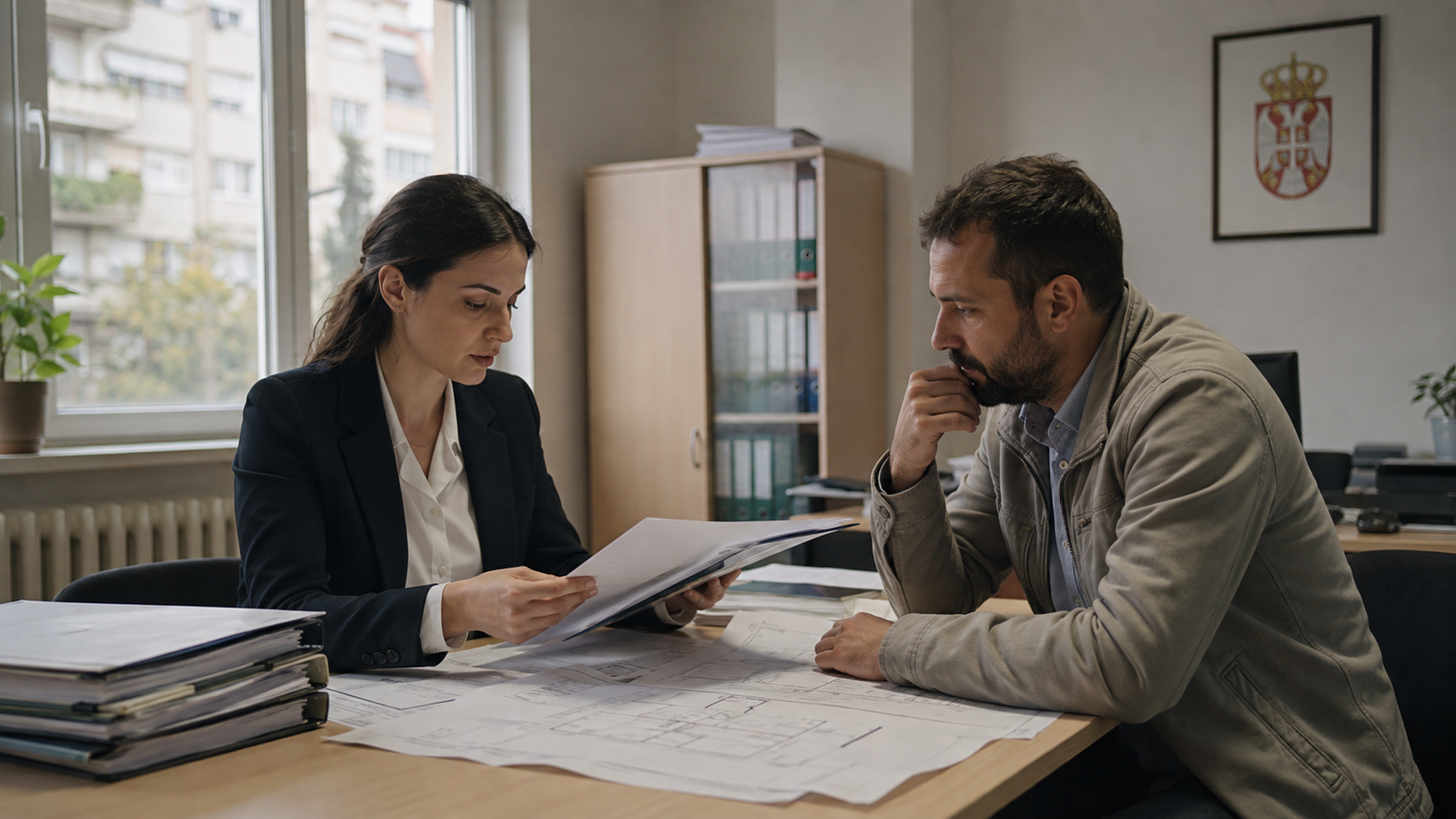
Can you buy an apartment that is not registered in Serbia?
The short answer is: in certain circumstances, yes.
However, saying that an apartment is “unregistered” does not tell you enough to know whether buying it is reasonable or excessively risky.
Sometimes the documentation is largely in order but an earlier agreement was never registered in the cadastre. In other cases, the apartment itself has not been properly recorded as an individual unit. There may also be problems involving old documents, property data or permits.
The better question is therefore not:
“Is the apartment registered?”
but:
“Why is it not registered, and how does the seller prove their right to sell it?”
What does an “unregistered apartment” actually mean?
In practice, the phrase can describe several different legal situations.
The building may appear in the cadastre while the apartment itself is not recorded as an individual unit. Alternatively, the apartment may exist in the records but the current seller may not be registered because an earlier sale was never entered into the cadastre.
There are also cases involving older documents with formal deficiencies that prevented registration for many years.
Since 1 January 2026, the Serbian Republic Geodetic Authority has also implemented a procedure known as targeted validation, designed to enable certain older documents to be reviewed and, where the statutory requirements are met, potentially used for cadastral registration.
Two apartments described in listings as “unregistered” can therefore have completely different legal circumstances.
Can an unregistered apartment be purchased?
The fact that the seller's right is not currently registered does not automatically mean that a transaction is impossible.
A useful practical indication is that the National Bank of Serbia expressly recognises housing loans for both registered and unregistered properties, while individual banks determine their lending requirements through their own policies.
This certainly does not mean that every unregistered apartment can be purchased safely.
Everything depends on the particular property and its documentation.
The key question: why is the apartment not registered?
This is the central issue.
There is a major difference between a seller who has a clear chain of older sale agreements that were simply never registered and a situation in which it is unclear how the seller acquired their rights in the first place.
In describing the current targeted validation procedure, the Republic Geodetic Authority identifies several types of problems involving older documentation that may be reviewed, including certain agreements without the required registration consent, discrepancies in property information, issues involving older permits and inconsistencies in personal data contained in old documents.
This does not mean that every such case will automatically result in registration.
The documentation is assessed individually and may be found unsuitable for registration.
A buyer therefore needs a clear answer to one question:
Why exactly is this particular property not properly registered today?
What is the chain of ownership and why does it matter?
With unregistered property, you may hear references to the chain of ownership or off-register ownership.
Put simply, the available documents need to connect the person selling the property today with the previous holders of rights.
If an apartment has changed hands several times without the buyers being entered into the cadastre, there may be a series of agreements showing how the rights passed from one person to another.
The National Bank of Serbia specifically notes that financing an unregistered property requires documentation establishing the chain of off-register ownership.
If that chain is unclear or contains significant gaps, the buyer's risk increases considerably.
Can you buy an unregistered apartment with a mortgage?
In some cases, yes, although this depends on the bank and the particular property.
The National Bank of Serbia states that housing loans exist for both registered and unregistered properties, while each bank sets its specific lending criteria.
A buyer should therefore not automatically conclude:
“It is unregistered, so no bank will finance it.”
But the opposite assumption is equally dangerous:
“My bank finances unregistered properties, so it will finance this one.”
The bank will review the particular property and documentation.
If your purchase depends on a mortgage, speak to the bank before paying a substantial deposit.
What if the apartment itself is not recorded as an individual unit?
This is different from a situation in which the apartment exists in the cadastral records but the current owner's rights have not been registered.
Current guidance from the Republic Geodetic Authority also addresses situations in which an individual unit — such as an apartment, commercial unit, garage or parking space — is not recorded in the cadastre. Additional documents from the relevant authority or professional technical documentation may be required, depending on the circumstances.
So the phrase:
“It is not registered”
is not precise enough.
You need to establish whether the apartment is missing from the register, the owner is not registered, or an entirely different issue exists.
What is targeted validation and why is it relevant now?
Since 1 January 2026, Serbia has had an additional procedure that is particularly relevant to some older unregistered properties.
Targeted validation allows certain older documents to be submitted to the Republic Geodetic Authority for review with a view to possible registration.
According to current RGZ information, the procedure can cover agreements concluded before 1 September 2014 and other qualifying documents created by 8 June 2018, together with specific cases prescribed by law.
It is equally important to understand what this does not mean.
It does not mean:
“Every unregistered apartment can now automatically be registered.”
Documents are reviewed, and where they are not suitable for registration the applicant receives information on possible next steps.
For a potential buyer, this can be useful because in some cases the seller may first attempt to resolve the registration issue before the purchase is completed.
Is it better for the seller to register the apartment first?
Where there is a realistic and relatively straightforward path to registration before the sale, this can often produce a cleaner transaction for the buyer.
Instead of purchasing the property and assuming responsibility for resolving the issue afterwards, the parties may agree that the seller should first address the registration problem.
This is not a universal rule.
Some procedures may take time, and some transactions may be capable of being structured properly even without the seller first completing final registration.
The appropriate approach depends on the documents and the specific reason why registration has not been completed.
Is an unregistered apartment necessarily cheaper?
There is no rule that an unregistered apartment must sell at a particular discount.
However, its legal status can affect market value through a simple mechanism: if fewer buyers are willing or able to purchase the property, its potential buyer pool becomes smaller.
If mortgage financing is more difficult or the transaction requires additional documentation, time and risk, that may influence what buyers are prepared to pay.
A €10,000 discount is not automatically a bargain if you are assuming a legal or administrative problem whose cost and outcome you do not understand.
What should you check before paying a deposit?
Due diligence on an unregistered apartment needs to go further than it would in a straightforward registered transaction.
Before paying, establish:
- what is currently recorded in the cadastre;
- whether the apartment itself is recorded as an individual unit;
- who is currently registered;
- which documents the seller relies on to establish their rights;
- whether there is a complete chain of relevant agreements and documents;
- why registration has not previously been completed;
- whether there is a realistic route to resolving the situation;
- whether your bank accepts the specific property if you are using a mortgage;
- what happens to your deposit if the transaction ultimately cannot be completed.
The final point in particular should not be left to a verbal understanding.
What should make a buyer particularly cautious?
The fact that a property is unregistered is not, by itself, a reason to walk away.
You should, however, exercise greater caution when nobody can clearly explain why it is unregistered or when the documentation is incomplete.
The same applies where there are gaps in the chain of agreements, significant discrepancies between the documentation and the physical property, or pressure to pay a deposit before the documents can be properly reviewed.
During the first months of the targeted validation procedure, the Republic Geodetic Authority reported unsuccessful applications involving incomplete or incorrect documentation, previously unresolved registration cases and missing supporting documents or technical evidence.
Simply having “some documents” is therefore not the same as having a secure legal basis for a transaction.
Registered or unregistered — what is the real difference for a buyer?
With a properly registered apartment, many of the most important facts can be checked directly through the public register.
With an unregistered apartment, you are more dependent on the documents used to reconstruct and prove its legal status.
That does not mean that one purchase is automatically good and the other automatically bad.
It means that the second transaction usually involves more questions that need clear answers before you commit.
This article therefore works directly with our previous guide explaining what it actually means when an apartment is registered in Serbia.
Conclusion
So, yes — an unregistered apartment can be purchased in certain circumstances. The National Bank of Serbia even recognises housing loans for certain unregistered properties.
But not all unregistered properties are alike.
The essential questions are why the apartment is not registered, what documentation exists, whether the chain of ownership can be established and whether there is a realistic path to resolving the cadastral status.
Since 2026, targeted validation has provided an additional route for addressing certain problems involving older documents, but it does not automatically turn every unregistered property into a straightforward transaction.
When buying this type of property, the first question should therefore not be how quickly you can pay the deposit.
It should be what exactly you are buying and which documents establish the seller's rights.
At Urbani Agent, that is how we approach more complex transactions: not by automatically rejecting every property with an issue, but by identifying what the issue is, whether it can be resolved and what it means for the buyer.
Note: This article is for informational purposes only and does not constitute legal advice. The ability to transfer, register or finance a particular property depends on its documentation and individual legal status.
Similar stories
The phrase “registered apartment” is often treated as proof that everything is in order. In practice, what matters is exactly what is recorded in the cadastre, who owns the property and whether any mortgages, notices or other encumbrances exist.
ReadBuying PropertyWhat should you check before buying an apartment?
Tax on the transfer of absolute rights?