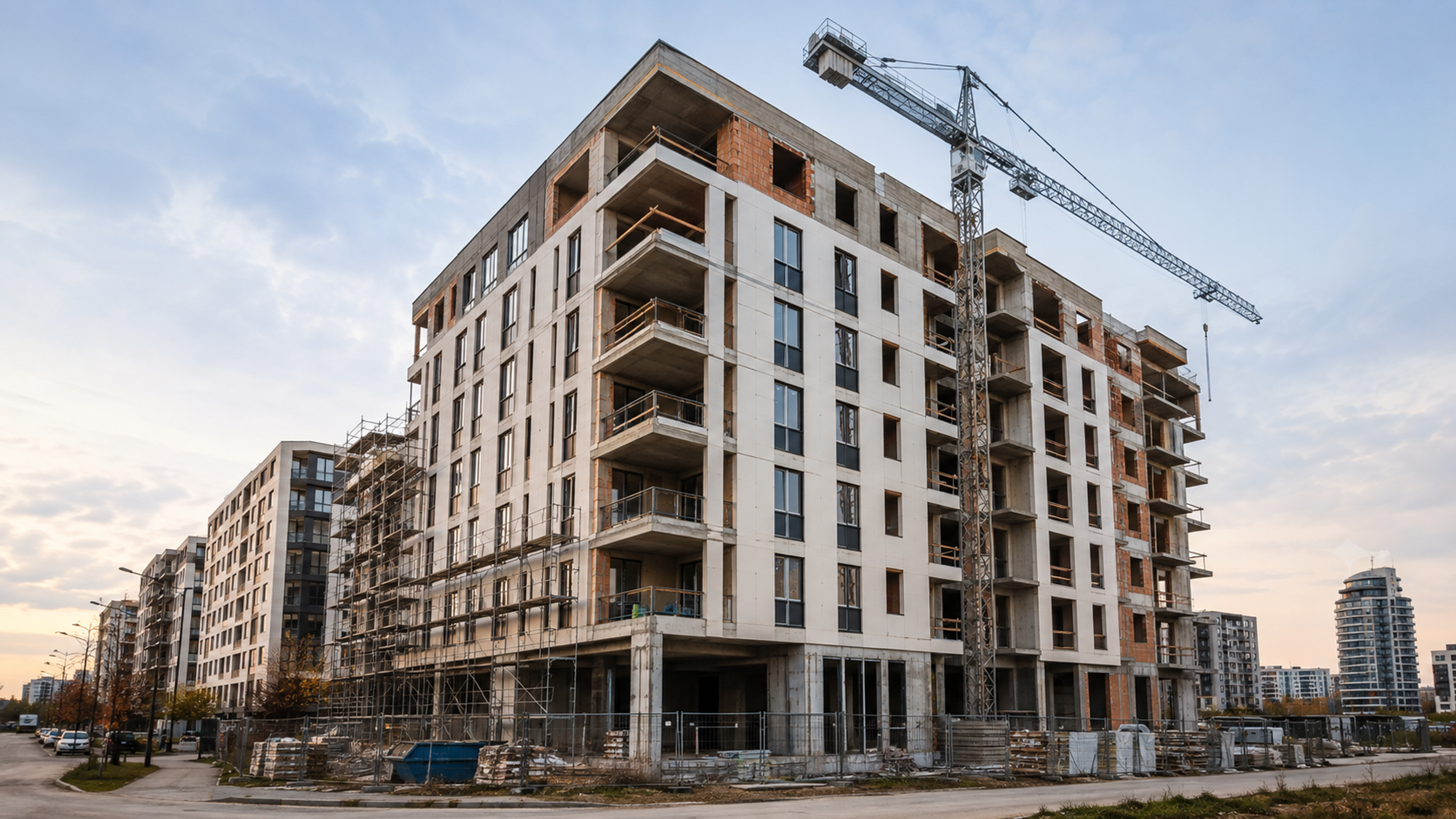
You like the apartment.
The location works.
The floor plan looks good.
The developer says the building will be finished in ten months.
There is only one issue:
the apartment you are buying does not yet exist in the form in which you will eventually receive it.
That is the fundamental difference between buying a completed apartment and buying one under construction.
You are not only checking what you are buying today.
You are also checking who is responsible for delivering it, what they are legally building, what they have promised to deliver and what happens if the project does not go according to plan.
Buying under construction is therefore not automatically a bad or unsafe purchase.
It simply requires a different type of due diligence.
1. Start by checking who the developer actually is
A polished sales office, attractive renders and a project Instagram account are not developer due diligence.
Start with the legal entity that will actually sign the agreement with you.
The Serbian Business Registers Agency — APR — provides public access to company registration data and published financial statements. APR also maintains a Central Register of Temporary Restrictions concerning certain restrictions affecting businesses and responsible persons.
Check:
- how long the company has existed;
- its legal representatives;
- whether the company is active;
- available financial statements;
- any relevant registered restrictions;
- previous projects delivered by the company or related group.
One important point:
the marketing name of the development and the legal entity selling the apartment may not be the same.
Check the company stated in the documentation, not only the name on the billboard.
2. Previous projects matter, but they are not a guarantee
A developer that has successfully completed several buildings gives you useful information.
You can see how previous developments have aged, speak with residents and investigate whether there were significant delays or delivery issues.
However, even an excellent track record does not replace due diligence on the specific project you are buying into.
Every project has its own land, permits, financing arrangements, contractors and agreements.
Reputation should therefore form part of your assessment.
It should not be the entire assessment.
3. Check the land and the rights relating to it
Before discussing apartment number 37 on the fifth floor, establish what is happening with the land underneath the building.
The Serbian Republic Geodetic Authority — RGZ — provides public eKatastar access to basic cadastral information and registered rights holders, searchable by parcel or address.
You need to understand:
who holds the relevant rights over the parcel, what legal basis the developer has for the project and whether relevant registered encumbrances or circumstances exist.
You do not personally have to become a cadastral-law expert.
But this needs to be checked before you commit substantial money.
4. Check the building permit
For a development under construction, the building permit is one of the first serious checks.
APR operates the Central Register of Unified Procedures — CEOP — through which public information relating to building permits and other stages of the construction procedure can be searched.
CEOP does not deal with only one permit.
The system covers procedures relating to the building permit, commencement of works, completion of foundations, structural completion, utility connections and the use permit.
This allows a buyer to assess where the project actually stands in the formal process, rather than relying exclusively on what the sales team says.
5. A building permit does not mean the entire process is complete
This distinction matters.
A building permit and a use permit represent different stages.
CEOP treats the building permit, commencement of works, construction milestones and use permit as separate stages of the process.
RGZ also refers to the relevant building and use permits and technical documentation when describing registration of completed buildings and their individual units where those permits have been issued.
So when someone tells you:
“Everything is legal — we have the building permit,”
that is important.
But it is not the end of the due diligence.
You should understand where the project stands today and what still needs to happen before proper completion.
6. Establish exactly what you are buying
With a completed apartment, you can walk inside and inspect the product.
During construction, you may be buying largely from plans.
That makes it essential to identify:
- apartment designation;
- floor;
- planned area;
- room configuration;
- terrace;
- storage or ancillary areas;
- parking or garage space;
- technical specification and finishes.
Do not rely on:
“It will look like the render.”
A render is a marketing visual.
The buyer should focus on the agreement, project documentation and the specification of what the developer is actually obliged to deliver.
7. What happens if the final area is different?
Address this in advance.
The final measured area can differ from the planned figure.
The agreement should therefore explain:
what happens if the completed apartment is larger or smaller than the area used to calculate the purchase price.
Will the price change?
At what price per square metre?
Is there an agreed tolerance?
When is the final calculation made?
Do not wait until the building is completed to ask for the first time.
8. Establish exactly what is included in the price
“€180,000 for the apartment” may not mean that €180,000 is the entire package.
Ask:
Is the garage extra?
Is storage included?
How is VAT treated?
Which finishes and equipment are part of the agreed standard?
Which buyer-requested changes cost extra?
Buyers often spend a great deal of time negotiating the price per square metre and not enough time establishing what those square metres actually include.
9. Look at the payment schedule, not only the price
An apartment under construction may involve payments in stages.
Different developments use different structures.
The critical point is for the contract to link clearly:
amount → date or construction milestone → condition for payment.
You should understand how much of your capital is exposed at each stage.
I would be particularly cautious where a very large proportion of the purchase price is payable early in the project while the buyer receives relatively weak contractual protection.
10. If you need a housing loan, speak to the bank before paying a substantial deposit
Your personal ability to borrow a certain amount does not automatically mean that every bank will finance every apartment under construction on identical terms.
The National Bank of Serbia explains that individual banks establish their housing-loan conditions under their own credit policies and that the market includes different forms of housing finance for different property situations.
If you depend on financing:
show the specific project and its documentation to the bank before taking on a substantial obligation to the developer.
“I'm sure the bank will finance it later” is not a financing plan.
11. Check the completion deadline carefully
“Move in by the end of the year” is not sufficiently precise.
The documentation should distinguish, where relevant, between:
- expected completion of construction;
- contractual completion deadline;
- any permitted grace period;
- handover conditions;
- consequences of delay.
Construction inevitably involves variables.
That is precisely why the agreement should define which events genuinely justify an extension and what happens when the developer simply fails to deliver on time.
12. Force majeure should not mean every problem the developer encounters
Read clauses allowing deadlines to be extended.
If the language is so broad that virtually every contractor problem, supply issue or organisational difficulty automatically excuses delay, the buyer may effectively be accepting a large part of the developer's ordinary business risk.
A sensible agreement can recognise genuinely exceptional circumstances.
But it should distinguish those circumstances from the normal operational risk of managing a construction project.
13. What happens if the developer is late?
This is one of the most important questions.
Do not ask only:
“When do they say it will be ready?”
Ask:
“What does the contract say if it is not ready then?”
Look at whether the agreement provides for:
- an additional period;
- contractual penalties, where agreed;
- termination rights in defined circumstances;
- return of funds if the agreement ends;
- other rights and obligations.
There is no single clause that suits every project.
The actual contract matters more than a verbal assurance from the sales office.
14. Pay attention to the developer's right to change the project
Perhaps you chose the apartment because of the windows, terrace, layout, view or design of the development.
Then you discover that the contract gives the developer very broad rights to change those things.
That deserves attention.
Some technical changes during construction can be entirely reasonable.
However, you should understand what can be changed without your consent and when a change would materially alter what you agreed to buy.
Pay particular attention to provisions concerning the floor area, layout, windows, terrace, materials, common areas and advertised amenities.
15. “Premium finishes” is not a technical specification
If quality matters, ask for greater precision.
For example:
flooring;
ceramics;
windows;
sanitary fittings;
heating and cooling;
entrance doors;
wall finishes;
electrical equipment.
It may be reasonable for the developer to use equivalent products where a specific product becomes unavailable.
But wording such as “premium materials selected by the developer” provides the buyer with very little objective standard against which delivery can later be assessed.
16. Do not overlook the parking space
If you are buying a garage or parking space with the apartment, treat it as an important part of the transaction.
Check:
- exact designation;
- position;
- dimensions and usability;
- whether it is a standard space or mechanical platform;
- legal status;
- whether it is included in the stated price;
- how it is described in the documentation.
“Parking available” is not enough.
A poorly positioned parking space can be a meaningful problem even in an otherwise excellent development.
17. When do you actually receive the keys?
Completion of physical construction, completion of formal procedures and physical handover are not necessarily the same date.
CEOP itself demonstrates that developments pass through multiple procedural stages before the use-permit stage.
The agreement should therefore define the condition under which possession will actually be handed over to the buyer.
Do not organise your entire move around a marketing phrase such as “move-in December” without understanding the contractual meaning behind it.
18. Handover is more than receiving a set of keys
Before formally accepting the apartment, inspect whether the developer has delivered what was agreed.
This may include checking windows and doors, floors, walls, ceramics, sanitary fittings, visible installations, terraces, equipment, visible damage and deviations from the agreed specification.
Any defects identified at handover should be recorded, together with the agreed procedure for rectification.
Excitement about receiving the keys should not replace inspection.
19. What happens with final registration?
Once construction is completed, the building and its individual parts need to proceed through the relevant cadastral process.
RGZ explains that registration of buildings with individual units relies on the relevant technical documentation and, where issued, the building and use permits.
Public notaries electronically forward documents that result in changes to the real-estate register after performing the relevant notarial procedure.
Do not therefore stop following the transaction the moment you receive the keys.
The objective is not only to move in. It is to complete the legal side of the purchase properly as well.
20. Does the public notary mean you do not need to check anything yourself?
That would be the wrong way to see the notary's role.
Real-estate transfer agreements must be executed in the prescribed notarial form. During the process, the public notary examines issues including the parties' legal capacity and authority, whether the transaction is legally permissible and explains its legal consequences.
That is an important safeguard.
But the notary does not decide for you whether you are comfortable with:
the price, payment schedule, permitted project changes, delay provisions, quality specification or commercial risk of the developer.
It is still your agreement and your purchase.
What should you check before paying a deposit or substantial first instalment?
Reduced to one practical checklist:
Who exactly am I signing with?
What is the developer's track record?
What land is the building being constructed on and what rights exist over it?
Is the relevant building permit in place?
Have works been properly recorded and what does CEOP show about the project's stage?
Which exact apartment am I purchasing?
How is any difference in final floor area treated?
What exactly is included in the purchase price?
What specification must the developer deliver?
What is the payment schedule?
What is the contractual completion and handover deadline?
What happens if the developer is late?
What is the developer permitted to change?
How are defects dealt with at handover?
If I need financing, will my bank finance this particular project?
If several answers are:
“Don't worry, that's standard,”
you still do not have an answer.
Ask for the document and the contractual mechanism.
Is an apartment under construction cheaper?
It can be.
Developers may use different pricing at different stages, and buyers entering earlier may have a wider choice of floors, orientations and apartment types.
However, any lower price is not a “free discount”.
The buyer is accepting a product that has not yet been completed and taking some completion and timing risk.
The more useful question is therefore not:
“How much cheaper is it if I buy now?”
but:
“Is the price difference sufficient for the conditions under which I am committing my money today?”
Is it better to buy early or late in the construction process?
Earlier in the project you may have more choice.
You also have longer to wait.
Later in the project, you can see more of the actual building, but the most desirable units may already be sold and pricing may have changed.
There is no universally correct stage.
A strong project with clear documentation and a credible developer can make an early purchase attractive.
Where significant questions remain unanswered, waiting for more progress may be worth more than securing the lowest possible early-stage price.
The biggest mistake when buying under construction
It is not necessarily buying too early.
It is not even paying slightly more than somebody else.
The biggest mistake is:
falling in love with the render and starting your due diligence only after transferring the money.
The order should be the opposite:
developer → land → permits → apartment → contract → financing → deadlines.
Then comes the serious money.
Conclusion
Buying an apartment under construction can be an excellent way to purchase a new home, choose from a wider selection of units and enter a development before completion.
But you are buying something that still has to be delivered.
That means checking more than the location, asking price and render.
APR and CEOP provide public information relating to companies and construction procedures, while RGZ provides access to cadastral information concerning property and registered rights.
Then comes the most important document:
what you have actually agreed with the developer.
It should make clear what you are buying, how much you are paying, when you pay, what must be delivered, when it must be delivered and what happens if the developer fails to perform as agreed.
At Urbani Agent, that is why we would assess the entire project before focusing only on the apartment.
With a property under construction, a good purchase begins long before the flooring, kitchen and keys exist.
Note: This article is for informational purposes only and does not constitute legal or financial advice. Documentation and contractual structures differ between developments, so the legal status and agreement should be reviewed for the specific transaction.
Similar stories
What should you check before buying an apartment?

How to protect your VAT refund
First-time buyers of new-build apartments in Serbia may qualify for a refund of part of the VAT paid. Here is who qualifies, how the eligible area is calculated and how the application process works
Read