“Which is better — a new build or an older property?”
This is one of the most common questions buyers ask, but it may be the wrong way to frame the decision.
What matters is not which option is generally better.
The more important question is which option better suits your needs, budget and lifestyle.
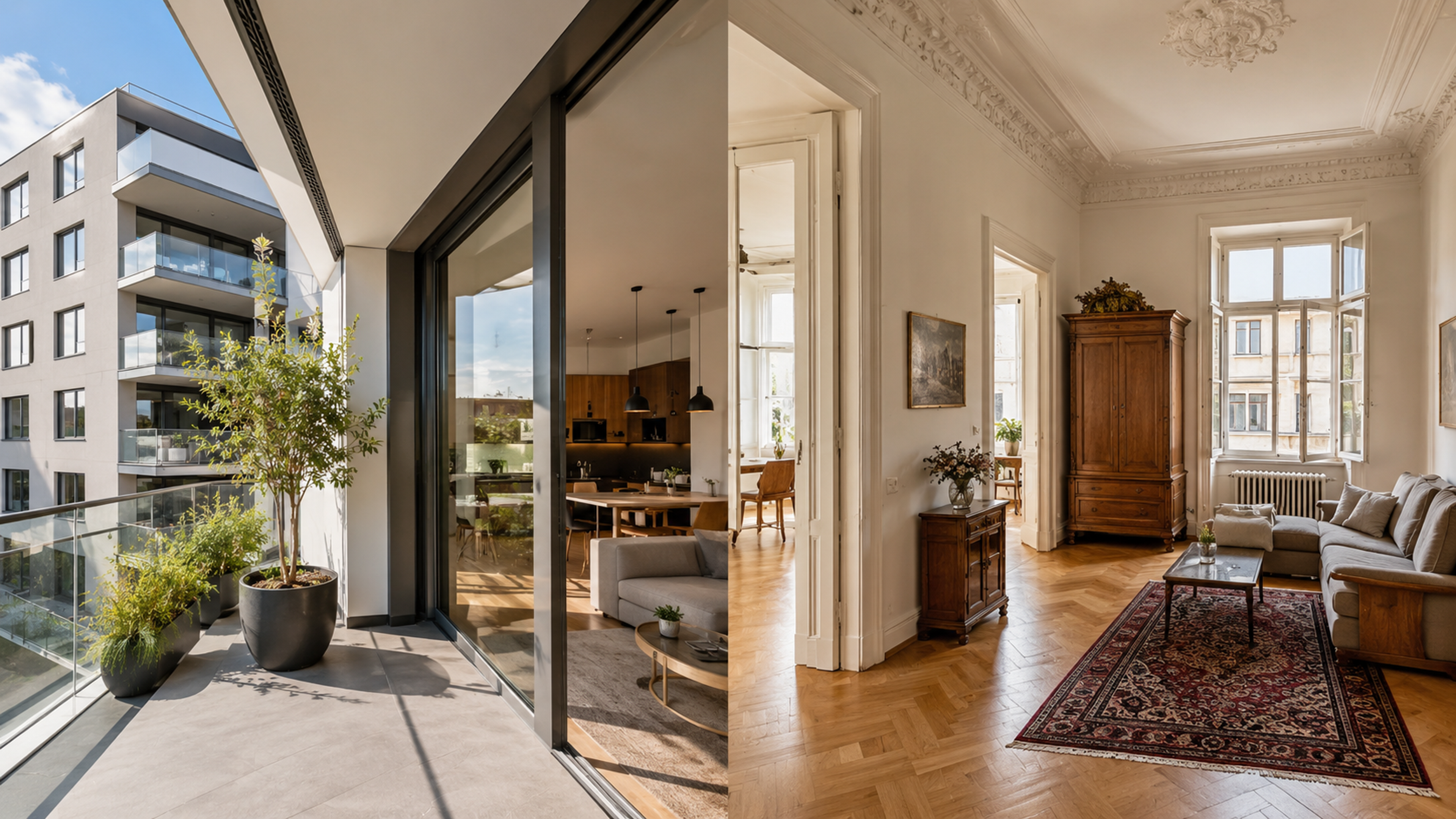
For some buyers, a new apartment, private parking and a modern building will matter more than the location. Others would rather choose an older property in an established neighbourhood with more greenery, stronger infrastructure and amenities that are already in place.
What does a new build offer?
The main advantage of a new build is that you are purchasing a new property that should not require major investment immediately after the purchase.
The installations, windows, lifts and shared areas should be new, while the layout and equipment are often designed for a contemporary lifestyle.
New developments are more likely to offer:
- private garage or parking spaces;
- modern lifts and well-maintained shared areas;
- newer installations and greater energy efficiency;
- contemporary materials and equipment;
- a choice of units during the earlier stages of a development;
- less need for immediate renovation.
For buyers who want to move in without organising contractors and months of renovation work, this can be a significant advantage.
However, a new apartment is not automatically a better purchase. Buyers should examine the quality of construction, the developer’s reliability, the documentation, completion deadlines and exactly what is included in the price.
What are the advantages of an older property?
Older properties are often found in locations that are already fully developed.
In these neighbourhoods, buyers usually know what they are getting: the schools, kindergartens, parks, shops, public transport and parking situation are already visible. You can assess how the building, entrance and immediate surroundings function instead of relying only on plans for future development.
Older properties may offer:
- stronger and more established micro-locations;
- more greenery and greater space between buildings;
- fully developed local infrastructure;
- larger rooms and higher ceilings in certain buildings;
- the opportunity to renovate according to your own preferences;
- a clearer picture of the building’s long-term quality.
On the other hand, an older apartment may require investment in its installations, windows, bathroom, kitchen or a complete renovation.
That is why comparing only the price per square metre is not enough. You also need to calculate the property’s true cost once it has been brought to the condition you want.
Location or the property itself?
In practice, the decision often comes down to a straightforward choice:
Would you rather buy a completely new apartment in a weaker location or an older property in a better one?
There is no answer that applies to everyone.
A family with children may prioritise proximity to schools, kindergartens, parks and relatives who live nearby.
For someone who drives every day, a private garage may be essential.
A buyer who works from home may prioritise peace, natural light and an additional room, while an investor will primarily consider rental demand, future development and potential return.
The location and the apartment should therefore not be assessed separately. A good purchase is one in which their relationship matches your individual priorities.
Compare the total cost, not only the asking price
A new build may have a higher initial price but require less investment after the purchase.
An older apartment may initially appear more affordable, but renovation, new installations, furnishing and parking can significantly increase the total cost.
Before deciding, consider:
- the purchase price;
- renovation and furnishing costs;
- the price of a garage or parking space;
- monthly maintenance expenses;
- the time required before moving in;
- the legal status and documentation;
- the property’s future resale or rental potential.
Only when all these costs are considered can the two options be compared realistically.
You are not buying only square metres
When you purchase a property, you are not choosing only an apartment.
You are also choosing the street you will use every day, the time required to reach work, the place where your children may play, the parking situation and the amenities available nearby.
A new build is therefore not automatically better simply because it is new. An older property is not automatically better merely because it is located in an established neighbourhood.
The right question is not: “Which is better?” It is: “Which is better for me?”